
Every trader knows the feeling: a stock or index starts running, your phone lights up, Telegram is celebrating, and a voice says “get in now or you’ll miss it.” That urge has a name — FOMO, the fear of missing out — and it is one of the most expensive emotions in Indian markets. Not because missing moves is costly, but because chasing them late is.
FOMO in trading is taking a position primarily because the move already started — and the pain of watching it continue without you feels worse than the risk of a bad entry. The motive is not your edge, your setup, or your plan. It is relief from the discomfort of being left out.
The tell is timing: a planned trade is entered when your conditions appear; a FOMO trade is entered after the confirmation you were supposed to wait for has long passed, usually at the worst part of the move — when early buyers are preparing to sell to you.
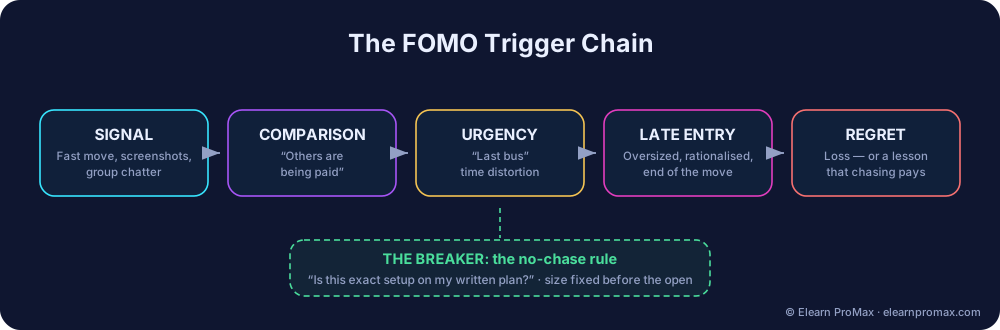
FOMO runs on a predictable chain. Naming the stages lets you interrupt them:
Signal. You see a fast move — a green candle streak, a breakout alert, someone’s screenshot, a trending index option.
Comparison. The brain registers other people are being rewarded and I am not. Behavioural research shows social comparison amplifies reward signals far beyond the raw numbers involved.
Urgency distortion. Time feels compressed: “this is the last bus.” In reality, the market offers setups every single day — but urgency hides that.
Rationalised entry. You construct a reason after the decision is already made — “momentum is strong,” “it will retest and continue” — and enter late, often oversized to “make up” for the part of the move you missed.
Regret either way. If it reverses, you take a loss on a trade that was never yours. If it works, the lesson your brain learns — chasing pays — is even more expensive over the next hundred trades.
- You enter after three or more candles in the direction of the move, with no pullback and no setup of your own.
- Your position size grows with your excitement — the faster the move, the bigger you go.
- You buy far out-of-the-money weekly options because they are “cheap” and the move “has to continue.”
- You feel physical urgency — racing pulse, fast clicking, skipping your checklist “just this once.”
- Your entries cluster in the last third of moves, and your stop-outs cluster at reversals.
- Screenshots and Telegram calls influence your entries more than your own written plan.
Indian index options concentrate FOMO into single sessions. On weekly expiry days, premiums on Nifty and Bank Nifty options can multiply within minutes — and screenshots of those multiples circulate instantly. Two structural facts make expiry FOMO especially dangerous:
- Cheap tickets, lottery odds. A ₹5 option can become ₹100 — which is exactly why it is priced at ₹5. Chasing these after the move begins means paying an already-inflated premium for a fading probability, with time decay accelerating against you into the close.
- Compressed time. Expiry gives no room to “wait for the retest.” The urgency is real — which is why the decision must be made before the session, in your plan, not during the spike.
SEBI’s own research (referenced below) found that the overwhelming majority of individual equity F&O traders lose money — and impulsive, late, oversized entries are one of the recognisable behaviour patterns behind that statistic.
You do not defeat FOMO with willpower in the moment; you defeat it with rules set when you are calm:
The three questions, out loud. Before any entry: Is this setup on my written plan for today? Was my entry condition met — or already gone? Would I take this exact trade if I had seen it first with no one else in it? Any “no” = no trade.
The no-chase rule. Write a mechanical cutoff, for example: no entry after the move has run more than N candles or X% without the pullback my setup requires. The exact number matters less than having one that removes the judgement call.
Pre-decided size. Position size is fixed the night before, per setup — never adjusted upward mid-session because a move looks strong. Excitement is not a sizing input.
The missed-trade log. Keep a column in your journal for moves you skipped and why. Within weeks you will see the truth your FOMO hides: disciplined skipping costs far less than undisciplined chasing.
Mute the amplifiers. During market hours, close the Telegram groups and P&L screenshots. Social comparison is FOMO’s fuel line — cut it at the source.
The market is not a train you can miss. It is an ocean with a wave every day. A missed move costs you nothing — the capital is intact, the next setup is coming, and your edge only exists inside your plan. At Elearn ProMax this is trained as part of emotional neutrality: the professional’s skill of watching a move happen without you, feeling the pull, and doing nothing. Not sure how strong your FOMO pattern is? Measure it with the free Trader’s Mind Scorecard.