
Most traders who revenge trade already know they shouldn't. That is the whole problem. Revenge trading is not a knowledge gap — it is an execution failure that happens when emotion overrides a plan you understand perfectly when you're calm. At Elearn ProMax we work on the trader behind the trading system, and revenge trading is one of the clearest examples of why: the fix is behavioural, not another indicator.
Revenge trading is entering a trade primarily to recover money you just lost, rather than because your setup and rules told you to. The market feels like it "took" something from you, and the trade is an attempt to take it back. Because the motive is emotional relief and not edge, the trade is usually larger, faster, and looser than your normal process allows — which is exactly why it tends to lose again.
It is distinct from a disciplined re-entry. Taking the next valid setup after a loss is normal trading. Doubling your size, dropping your criteria, or jumping into an instrument you don't usually trade, minutes after a stop-out, to "make it back" — that is revenge.
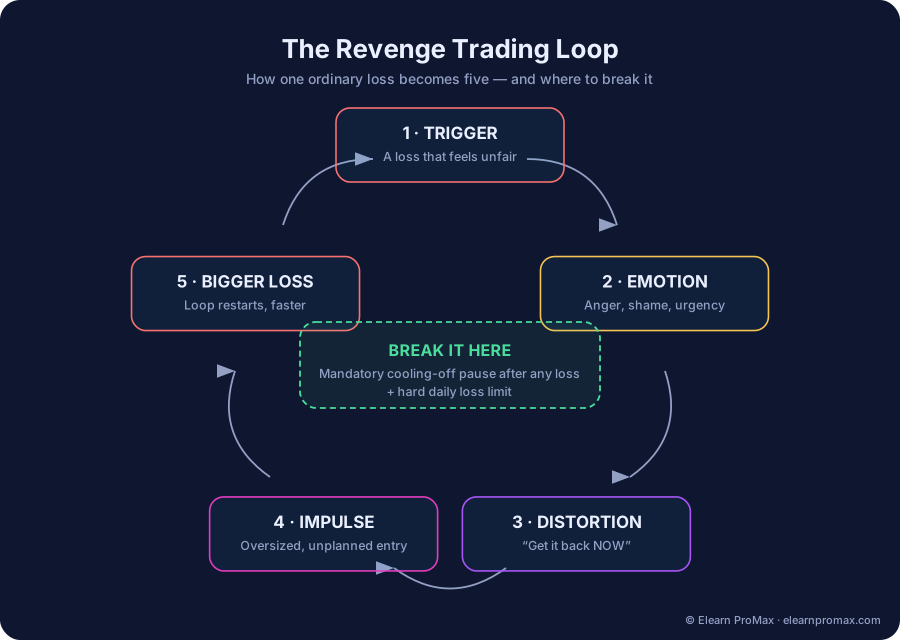
Revenge trading runs as a self-reinforcing loop. Naming each stage is what lets you interrupt it:
Trigger. A loss, especially one that feels unfair — a stop-out just before the move continued in your direction, or a fast expiry-day reversal.
Emotion. Anger, shame, and a spike of urgency. Physiologically this is a stress response; attention narrows and patience collapses.
Distorted thinking. "I need to get it back now." Time-horizon shrinks to this minute; risk feels irrelevant next to the pain of the loss.
Impulsive action. An oversized, unplanned entry, often with the stop widened or removed.
Usually another loss — which intensifies the emotion and starts the loop again, faster and bigger.
The danger is compounding: a single ordinary loss becomes a sequence of larger ones. Left unbroken, one bad ten minutes can undo weeks of disciplined work.
Revenge trades feel urgent and justified in the moment, so you cannot rely on judgement to catch them — you need a checklist you trust more than your state of mind. Watch for:
- Increasing position size after a loss.
- Re-entering within seconds or a minute or two of being stopped out.
- The phrase "just one more trade to get back to breakeven."
- Trading an instrument or timeframe outside your plan (e.g. jumping to weekly Bank Nifty options you don't normally trade).
- Widening or removing your stop-loss "to give it room."
- Refreshing your P&L obsessively; a tight jaw, shallow breathing, or a racing feeling.
- Telling yourself the market "owes" you.
The following is a hypothetical, composite scenario for education — not a real client, not a recommendation, and not a claim about returns.
It's expiry day. A trader takes a planned Bank Nifty option-buying trade with a defined risk. The market ticks against them and hits the stop. Nothing unusual — one loss, well within the plan. But the stop-out lands seconds before price snaps back the way they'd expected. It feels stolen.
Instead of pausing, they immediately re-enter — this time double the size, no written stop, "because it's obviously going to move now." It doesn't. Loss two, larger than loss one. Now angry, they switch to buying cheaper, further out-of-the-money options and fire three more trades in ten minutes chasing the recovery. By the close, a day that started with one small, acceptable loss has turned into a drawdown several times bigger than their daily limit — and none of the extra trades were in the plan.
Notice what actually happened: the strategy never failed. The first loss was normal. The damage came entirely from the loop after it. That is revenge trading, and it is fixable — mechanically.
You cannot regulate a stress response with willpower once it's firing. You install the controls in advance, when you're calm:
A hard daily loss limit that ends your session. Decide, before the market opens, the maximum you are willing to lose in a day — as a rupee figure or a percentage of capital. When you hit it, you are done for the day, full stop. Where your broker supports daily loss limits or trade caps, set them so the decision isn't left to your worst moment.
A cooling-off rule after every loss. Write a fixed rule such as: after any single loss, no new trade for the next set period (for example, until the next candle closes, or a fixed number of minutes). After two consecutive losses, stop for the day. The exact numbers matter less than making the pause automatic and non-negotiable. The pause exists to let the stress response settle so your normal judgement returns.
A pre-committed trade plan. The night before, write your setups, your size, and your maximum number of trades. A revenge trade is, by definition, one that isn't on that list. If it's not pre-committed, it doesn't get taken.
- The 90-second reset. The acute wave of a stress response passes quickly if you don't feed it. After a loss, step back from the screen and take slow breaths for a minute or two before touching the order pad.
- The one question. Before any entry ask: "Is this exact trade in my written plan for today?" If the honest answer is no, you don't take it. No exceptions during the session.
- Size down, don't up. The correct response to a loss is never a bigger position. If anything, reduce size while you re-establish rhythm.
Behavioural correction happens after the session, not during it. Before your next trading day, run a short post-loss review:
- What was the trigger — which loss, and why did it feel unfair?
- What did I feel, in the body, in that moment?
- Which trades were in my plan, and which were revenge?
- What will I change tomorrow — a tighter daily limit, a longer pause, smaller size?
Logging the trigger and the emotion — not just the entry and exit — turns an invisible impulse into visible data. That's the raw material for genuinely retraining the pattern, and it's exactly the journaling-with-emotion-tags approach taught across the Elearn ProMax programs. Not sure where you stand today? Measure your starting point with the free Trader's Mind Scorecard.
Score one point for each "yes" about your trading in the last month:
- I have increased my size right after a loss to recover faster.
- I have re-entered within a minute or two of being stopped out.
- I have widened or removed a stop-loss after a losing trade.
- I have kept trading past the point I'd planned to stop, to get back to breakeven.
- I have traded an instrument or timeframe outside my plan after a loss.
- I check my P&L constantly and feel the market "owes" me.
0–1: occasional urge — reinforce your rules. 2–3: a forming pattern — put the cooling-off rule and daily limit in place now. 4–6: an active revenge pattern that is likely costing you more than any strategy flaw — this is exactly what structured behavioural work is for.
| When | Do this |
|---|---|
| Before the session | Write today's setups, size, max trades, and your hard daily loss limit. |
| Immediately after a loss | Step back. 90-second breathing reset. Start your cooling-off timer. |
| Before the next entry | Ask: "Is this in my written plan?" If no, skip it. |
| After two losses in a row | Stop for the day. The loop is more expensive than tomorrow's opportunity. |
| End of day | Run the post-loss review; log the trigger and emotion, not just the trade. |