Ask a hundred losing traders what went wrong and most will name an emotion: panic-exited, greed-held, FOMO-chased, revenge-doubled. Yet the standard advice — “control your emotions” — is useless, because it is an instruction with no method. This guide is the method: what each major emotion actually does to your decisions, how they chain into each other, and the two-level system (body-level and rule-level) that professionals use so that feelings stop becoming orders.
Under live-market pressure the brain treats financial threat much like physical threat: attention narrows, time-horizon shrinks, and action feels urgent. That state is excellent for escaping danger and terrible for probabilistic decisions. The trader’s problem is not having emotions — it is that unnoticed emotions convert directly into behaviour: fear becomes an early exit, greed becomes an oversized hold, anger becomes a revenge entry. The entire craft of emotional control is inserting a gap between feeling and action — and filling that gap with a rule.
Fear — exits too early, freezes entries
Fear makes winners unbearable to hold and valid setups impossible to take. Its signature: cutting profitable trades at the first wobble while your plan said hold. Read the full guide →
Greed & FOMO — enters late, sizes up
The reward system chasing other people’s profits: late entries, oversized positions, cheap expiry options. See the FOMO guide and the brain science behind it →
Anger — trades to get even
The revenge loop: a painful loss becomes an oversized, unplanned re-entry, which becomes a bigger loss. The full step-by-step system to break it →
Hope & denial — holds losers
Loss aversion’s children: widening stops, averaging down, “it will come back.” Why losses feel twice as heavy as gains — and what that does to exits →
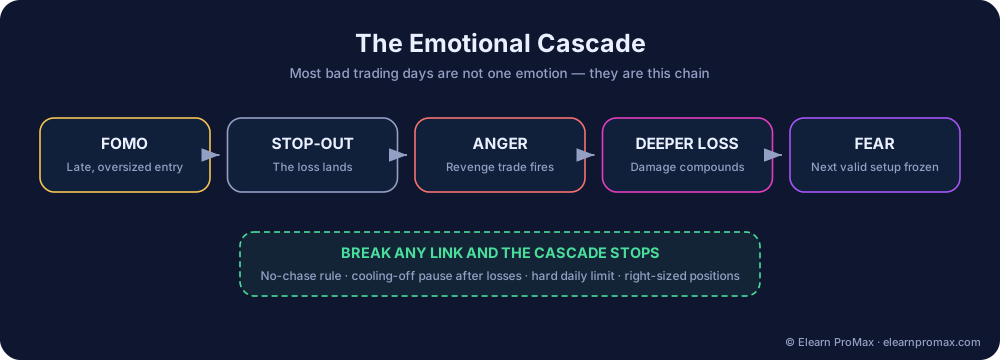
These forces chain: fear of missing out causes a late entry; the late entry stops out; the loss triggers anger; the revenge trade deepens it; the deepened loss breeds fear that freezes the next valid setup. Most bad trading days are not one emotion — they are this cascade. Break it at any link and the whole day changes.
Notice and name. The foundational skill: say — ideally out loud — “this is FOMO,” “this is revenge urge.” Naming an emotion engages the observing mind and measurably reduces the emotion’s grip on behaviour. You cannot regulate what you have not noticed.
Slow the breath. Extended exhales for sixty to ninety seconds signal safety to the nervous system and widen attention again. It is the fastest lever you own, and it works precisely because the stress response is physical, not intellectual.
Change posture, break the trance. Stand, step back from the screen, look at something distant. Physical state-change interrupts the narrowing spiral that keeps you glued to the next tick.
Body-level tools buy you seconds of clarity; rules decide what happens in those seconds. Each emotion gets a pre-written rule so no in-the-moment judgement is needed:
- For fear: exits are defined with the entry — stop and target placed with the order — and the position is sized small enough that holding the plan is bearable. If you cannot hold it calmly, it is too big.
- For FOMO: a no-chase rule (no entry after the move has run without your setup’s condition), and size fixed before the session — excitement is never a sizing input.
- For anger: a mandatory cooling-off pause after any loss, and a hard daily loss limit that ends the session mechanically.
- For hope: stops are placed with the order and never widened; averaging into a losing position is banned in writing.
Notice the pattern: every rule converts an emotional decision into a mechanical one, made when you were calm. That is the entire architecture of emotional control — and why journalling with emotion tags matters: it shows you exactly which rule your pattern needs most.
The goal is not a trader who feels nothing — it is a trader whose state does not swing with the P&L: profits without euphoria, losses without tilt, a missed move without urgency. That is emotional neutrality, one of the four working areas of the Elearn ProMax curriculum, and it is trained — through daily practice, journalling, and repetition under gradually increasing stakes — not wished into existence. The deep-dive on what neutrality is (and is not) lives in the emotional neutrality guide.
Indian market hours have an emotional geography worth naming in your plan: 9:15–9:30 — opening volatility, where fear and FOMO are strongest and unplanned entries most expensive; expiry afternoons — premium spikes engineered to trigger chasing; the post-lunch drift — boredom’s overtrading window; 3:00–3:30 — urgency to “finish green,” the classic revenge window. A plan that names these windows — and applies stricter rules inside them — is emotional control implemented as schedule. SEBI’s research (below) on individual F&O outcomes is the sobering context: the majority lose, and unmanaged emotion is the most correctable reason why.
Start by measuring which emotion dominates your trading with the free Trader’s Mind Scorecard — then build the rule that emotion needs.